
3D Printer Filament Guide for Bangladesh: PLA, PETG, ABS, ASA, TPU and Composites
Which 3D printer filament to use for which part, how the common materials compare on heat and moisture, and how to store filament in Bangladesh's humid climate.
Updated October 2026. This guide replaces an article first published on PrototypeBD in September 2025. The material data, storage advice and product availability below were checked again in October 2026; the 2025 prices and brand list no longer apply.
Buying 3D printer filament in Bangladesh comes down to two decisions: which plastic suits the part, and how you will keep that plastic dry in a country where indoor air is humid for most of the year. This guide compares the common FDM materials (PLA, PETG, ABS, ASA, TPU, PC and the carbon-fibre composites) using manufacturer data, explains what Dhaka's humidity means for storage, and lists what PrototypeBD actually stocks and prints today.
PrototypeBD stocks Bambu Lab 1.75 mm filament, with PLA Basic from BDT 1,650 (prototypebd.com, October 2026); see the Filament category for the current range.
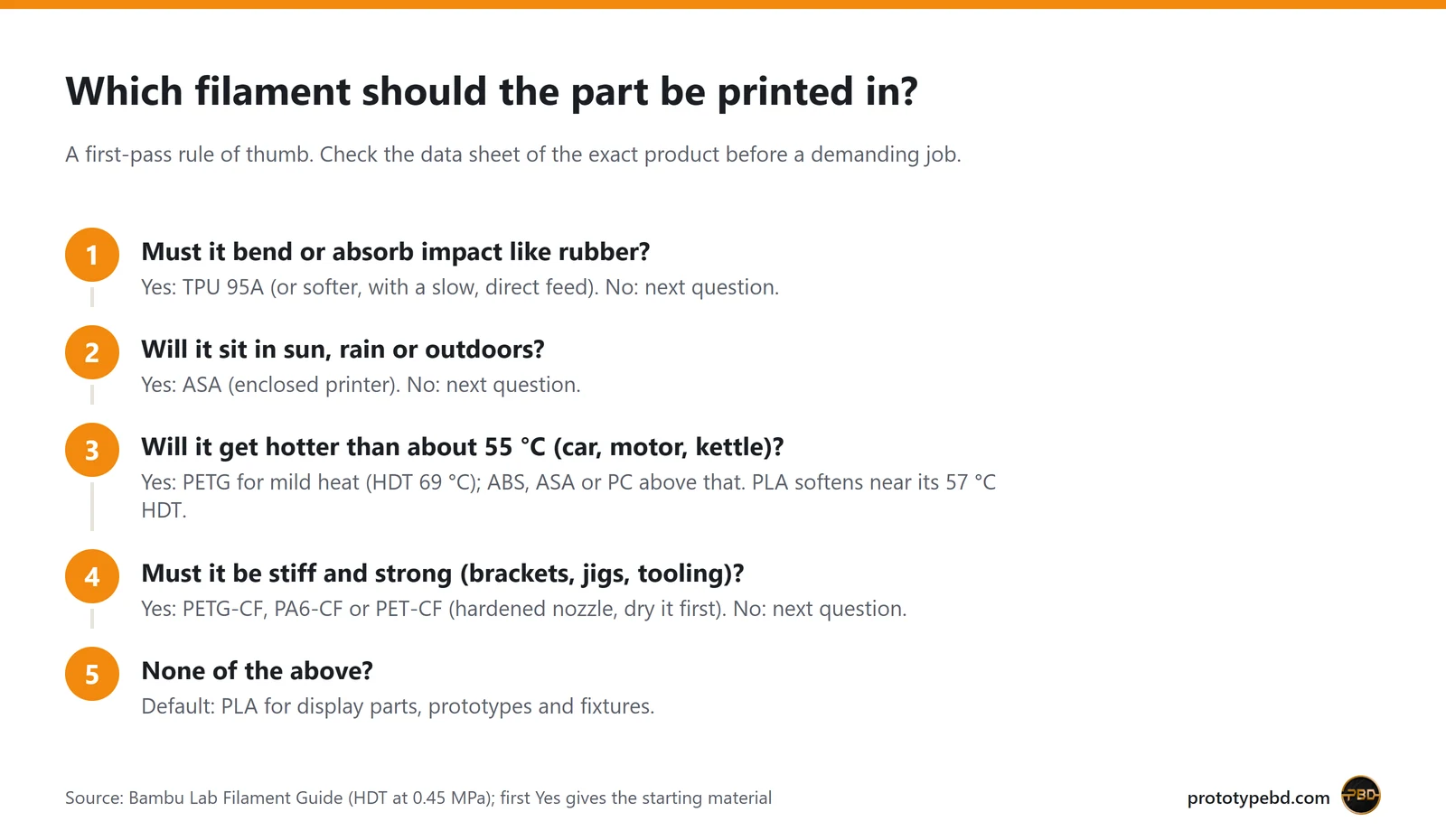
Quick answer: which filament for which job
- PLA for most first prints, display models, prototypes, organisers and indoor fixtures. It is the easiest material to print and the most forgiving on open-frame printers.
- PETG when a part needs more toughness and a little more heat resistance than PLA, for example clips, brackets and containers.
- ASA for parts that live outdoors, in sun and rain. ABS is the indoor relative; both want an enclosed printer.
- TPU for flexible parts: gaskets, bumpers, grips and phone cases.
- PC and fibre-filled nylon or PET for hot, stiff or load-bearing engineering parts. These need a hardened nozzle, high temperatures and properly dried filament.
Filament comparison table (manufacturer data)
The figures below come from the Bambu Filament Guide, which reports test results for Bambu Lab's own products. They are useful because every material was measured the same way, but another brand's PETG or ASA will not match them exactly. Heat deflection temperature (HDT) is measured at a light 0.45 MPa load, and water absorption is the saturated value at 25 °C and 55 % relative humidity.
| Material | Nozzle (°C) | HDT, 0.45 MPa | Water absorption | Dry before use | Typical parts |
|---|---|---|---|---|---|
| PLA | 190–230 | 57 °C | 0.43 % | Optional | Models, prototypes, indoor fixtures |
| PETG | 240–270 | 69 °C | 0.32 % | Optional | Tough functional parts, containers |
| ABS | 240–280 | 87 °C | 0.65 % | Optional | Indoor housings, heat-exposed parts |
| ASA | 240–280 | 100 °C | 0.45 % | Optional | Outdoor and UV-exposed parts |
| PC | 260–290 | 117 °C | 0.25 % | Required | Hot, tough engineering parts |
| TPU 95A | 220–240 | not listed | 1.16 % | Required | Flexible gaskets, bumpers, grips |
| PLA-CF | 210–240 | 55 °C | 0.42 % | Optional | Stiff, matte prototypes and jigs |
| PETG-CF | 240–270 | 74 °C | 0.30 % | Optional | Stiff functional parts |
| PA6-CF | 260–300 | 184 °C | 2.35 % | Required | Strong, stiff functional parts |
| PAHT-CF | 260–300 | 194 °C | 0.88 % | Required | Stiff parts that must hold shape when hot |
| PET-CF | 260–300 | 205 °C | 0.37 % | Required | Dimensionally stable hot parts |
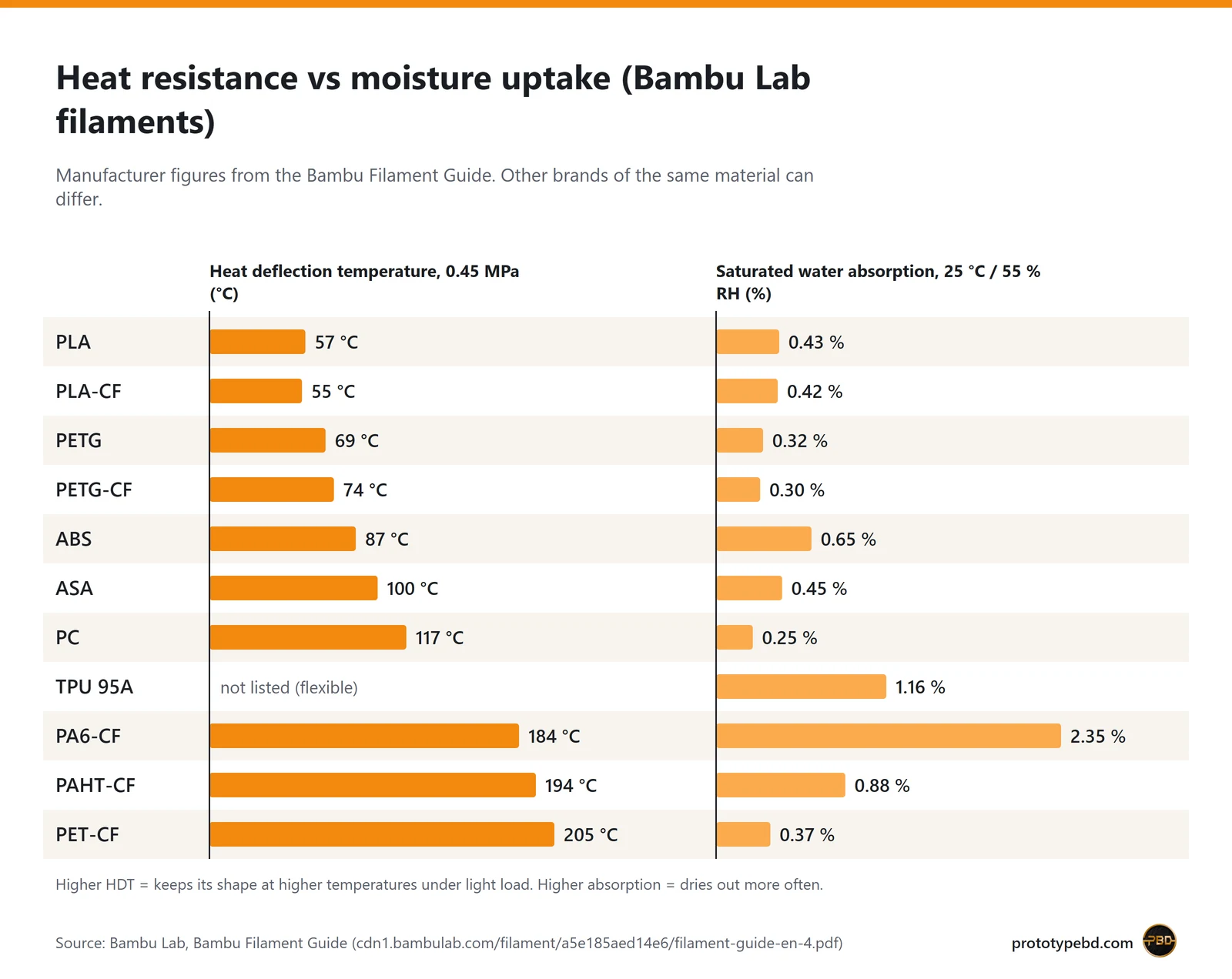
Two practical points follow from the data. First, PLA softens at temperatures that the inside of a car parked in the sun can reach (a widely reported risk, not a test figure), so anything that sits in a vehicle, near a motor or under a lamp should move up to PETG, ASA or better. Second, the strongest materials are also the most demanding to print: every carbon-fibre grade in the guide calls for a hardened steel nozzle, and the nylon and PET composites list print speeds under 100 mm/s.
The materials one by one
PLA and its variants
PLA prints at low temperature, sticks well to a textured or smooth plate, and barely warps, so it works on almost any FDM printer. The "Basic", "Matte", "Silk", "Wood" or "Glow" labels are mostly about appearance; the mechanical behaviour stays close to plain PLA. Stiffer or tougher blends (sold under names such as PLA Tough, PLA+ or PLA-CF) exist, but those names are marketing terms rather than a standard, so compare data sheets rather than labels. The main limit is heat: with an HDT of 57 °C in Bambu Lab's test, PLA is an indoor material.
PETG
PETG trades a little stiffness for much higher impact strength (52.7 kJ/m² against 26.6 kJ/m² for PLA in the Bambu guide) and a higher HDT of 69 °C. It prints hotter (240–270 °C) and tends to string if it is wet or the nozzle is too hot. It is a good default for functional parts that are not exposed to direct sun or engine heat.
ABS and ASA
ABS and ASA are the classic "engineering" plastics of desktop printing, with HDTs of 87 °C and 100 °C in the Bambu data. Both shrink as they cool and warp on large flat parts. Prusa's knowledge base recommends printing ABS inside an enclosure, with a bed around 100 °C, in a well-ventilated room because of the fumes. ASA behaves similarly but resists UV, which makes it the better choice for outdoor fittings, signage and parts on balconies or rooftops. ABS can also be smoothed with acetone vapour; ASA is chosen mostly for weather resistance.
TPU (flexible)
TPU is rated by Shore hardness: lower numbers are softer and harder to print. Prusa's flexible materials guide puts typical TPU at 60A–90A and recommends slow printing; Bambu Lab lists TPU 95A at under 80 mm/s and marks drying as required, with the highest water absorption of the common materials (1.16 %). A direct-drive extruder makes softer grades much easier to feed.
PC and fibre-filled composites
Polycarbonate (HDT 117 °C) and the carbon-filled nylons and PET (184–205 °C) are for parts that must stay stiff when hot: fixtures near machinery, brackets in engine bays, tooling. The Bambu guide lists nozzle temperatures up to 300 °C, a hardened steel nozzle for every fibre-filled grade, and drying as required before printing. Check that your hotend can reach those temperatures and that the printer has an enclosure before buying these materials.
Humidity in Bangladesh: why storage matters more than brand
Filament absorbs water from the air. Bambu Lab's drying guide explains what happens next: the water boils inside the hot nozzle, so the melt bubbles and extrudes unevenly, which shows up as stringing, oozing, holes, rough surfaces and weaker parts. The effect grows with ambient humidity and with the time a spool sits open.
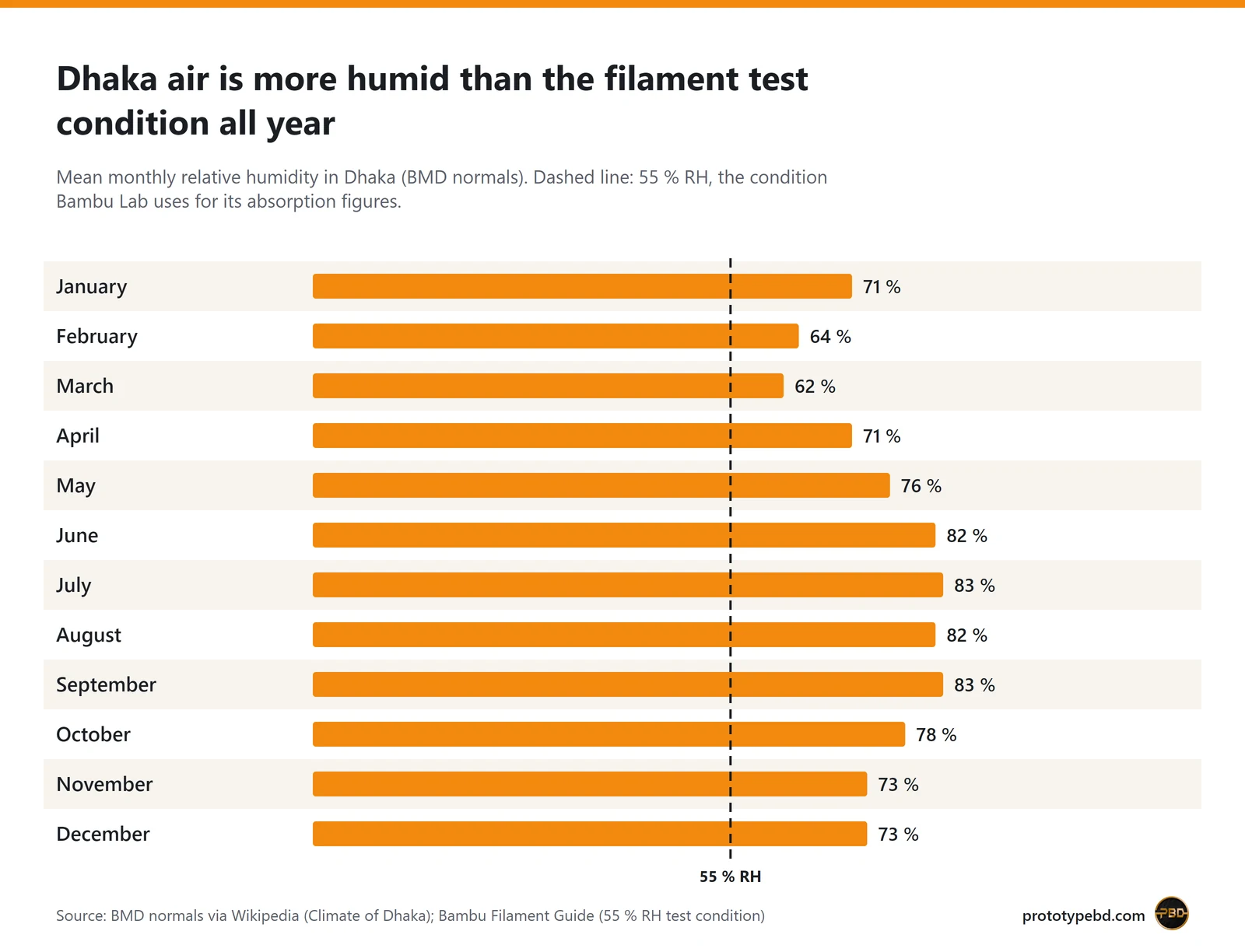
That matters here because Dhaka's air is damp all year. Bangladesh Meteorological Department normals, as reproduced in the Climate of Dhaka article, give a mean relative humidity of 62 % in March, the driest month, and 82–83 % from June to September, with an annual mean of 75 %. Every month is above the 55 % RH condition that Bambu Lab uses for its absorption figures.
A storage routine that works in a humid climate
- Keep spools sealed. Return each spool to an airtight bag or box with desiccant (silica gel) after printing. Bambu Lab's guide marks "seal with desiccant" for every material.
- Watch the humidity. A cheap hygrometer card or sensor inside the box tells you when the desiccant is spent and needs drying or replacing. This is general good practice rather than a manufacturer rule.
- Dry before demanding prints. PC, TPU and all nylon or PET composites should always be dried. PLA, PETG, ABS and ASA can usually be printed straight from a sealed bag, but dry them if a spool has been open during the monsoon or prints start stringing.
- Dry at the right temperature. Use a filament dryer or a blast drying oven at the temperatures below. Too much heat softens PLA and TPU, so the layers on the spool can stick together.
| Material | Blast drying oven (Bambu Filament Guide) |
|---|---|
| PLA, PLA-CF | 55 °C, 8 h |
| PETG, PETG-CF | 65 °C, 8 h |
| TPU 95A | 70 °C, 8 h |
| ABS, ASA, PC | 80 °C, 8 h |
| PA6-CF, PAHT-CF, PET-CF | 80 °C, 8–12 h |
Bambu Lab also describes drying on the heated bed of an enclosed printer under a cover, and notes that open-frame printers such as the A1 and A1 mini cannot be used for this. Its AMS 2 Pro dries only up to 65 °C, so materials that need 80 °C may not dry fully in it. If you buy a refill (spool-less) coil, wind it onto a reusable spool before drying.
Printer checklist before you buy a new material
- Diameter: almost all current desktop printers use 1.75 mm filament; confirm yours does.
- Nozzle: every carbon-fibre ("-CF") grade in the Bambu guide needs a hardened steel nozzle; glass-filled ("-GF") grades are also abrasive, and a brass nozzle wears out quickly.
- Temperature: PC and the nylon or PET composites need a hotend that reaches 260–300 °C.
- Enclosure: ABS, ASA and PC print far more reliably in an enclosed printer; PLA and TPU prefer an open or ventilated one.
- Feed path: soft TPU feeds best through a short, direct path; check whether your multi-material unit supports it.
- Fit clearance: for press-fit and snap-fit parts, PrototypeBD generally designs a 0.1 mm clearance, and between 0.1 and 0.3 mm depending on the material and the precision of the printer. Test a small fit piece when you change material.
If you are still choosing a machine, the 3D printers category lists the printers PrototypeBD currently sells.
What PrototypeBD sells and prints (October 2026)
The Filament category on prototypebd.com currently lists Bambu Lab 1.75 mm filaments only. The range covers PLA (Basic, Matte, Silk+, Tough+, translucent, metal, marble, wood, glow, CF and more), PETG (Basic, HF, translucent, matte, CF), ABS and ABS-GF, ASA, ASA-CF and ASA Aero, PC and PC FR, TPU 85A/90A, TPU 95A HF and TPU for AMS, and engineering grades such as PA6-CF, PA6-GF, PET-CF and PPA-CF.
- Bambu Lab PLA Basic is the one material with a listed price: BDT 1,650 for a 1 kg refill and BDT 1,850 for 1 kg with a spool (prototypebd.com, October 2026). At the time of writing the with-spool option is out of stock and colour availability varies, so check the listing before ordering.
- Most other filament listings currently show "Contact for price", which means price and stock are confirmed on request rather than shown online. The PETG HF listing notes that the manufacturer lists it as discontinued.
- All listings can be browsed by brand on the Bambu Lab brand page.
If you need parts rather than spools, the FDM 3D printing quote page accepts STL, 3MF and OBJ files (STEP and STP files are accepted too, but staff price them by hand) and offers PLA, PETG, ABS, ASA, TPU, PA and PLA-CF. The file is sliced automatically, a price is calculated, and the quote PDF is sent on WhatsApp; parts are printed in-house, checked and delivered by courier nationwide. PrototypeBD prints mostly on Bambu Lab printers such as the P1S and P2S, and large parts on a Creality Ender-5 Max.
FAQ
Is PLA+ stronger than PLA?
Sometimes, but "PLA+" is not a defined standard: each maker blends it differently. Compare impact strength and HDT on the technical data sheets of the two products you are considering.
Can I print ABS or ASA on an open-frame printer?
Small parts can work, but large flat parts usually warp and crack without a warm enclosure. Prusa recommends an enclosure for ABS and for large ASA parts, plus good room ventilation.
How do I know my filament is wet?
Typical signs are popping or hissing at the nozzle, more stringing than usual, rough or bubbly surfaces and brittle filament. Drying the spool at the recommended temperature and printing again is the quickest test.
Which filament is best for outdoor use in Bangladesh?
ASA, because of its UV resistance and 100 °C HDT. PETG is acceptable for shaded outdoor parts; PLA is not suitable for sun and heat.
Should I buy a refill or a spool?
A refill is the filament coil without the plastic spool and is cheaper if you already own a compatible reusable spool. Buy the version with a spool for your first roll of a given type.
Next step
For everyday printing, start with PLA and a sealed storage box; move to PETG, ASA, TPU or a composite only when the part needs it. Browse the current range in the Filament category, or if you would rather have the part printed for you, upload your model on the FDM quote page to get a price.
Related articles
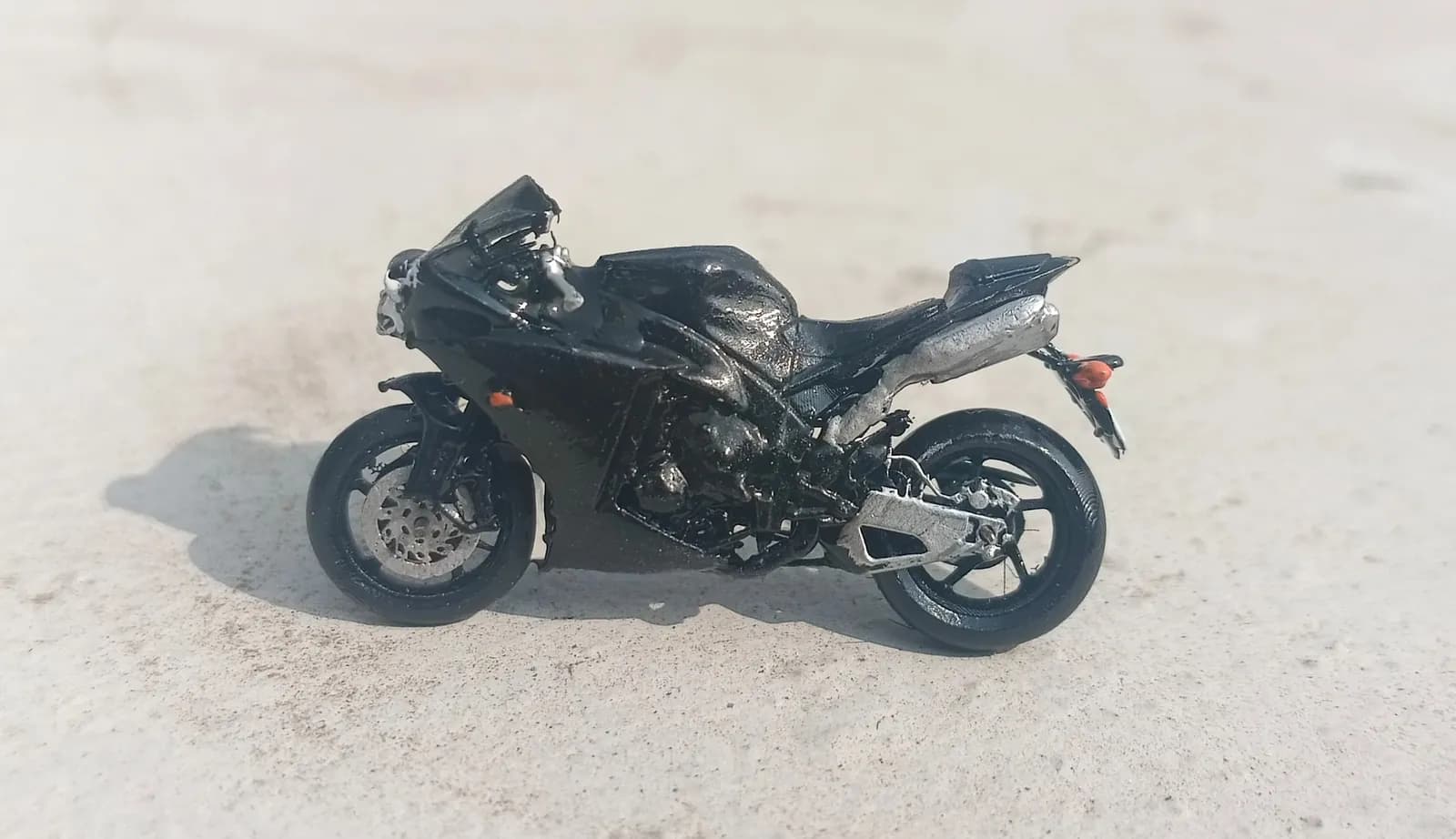
FDM vs SLA: which 3D printing process suits your part
FDM for parts that must work, SLA resin for parts that must look perfect up close. A sourced comparison of detail, strength, size, cost, post-processing and safety, with a checklist.
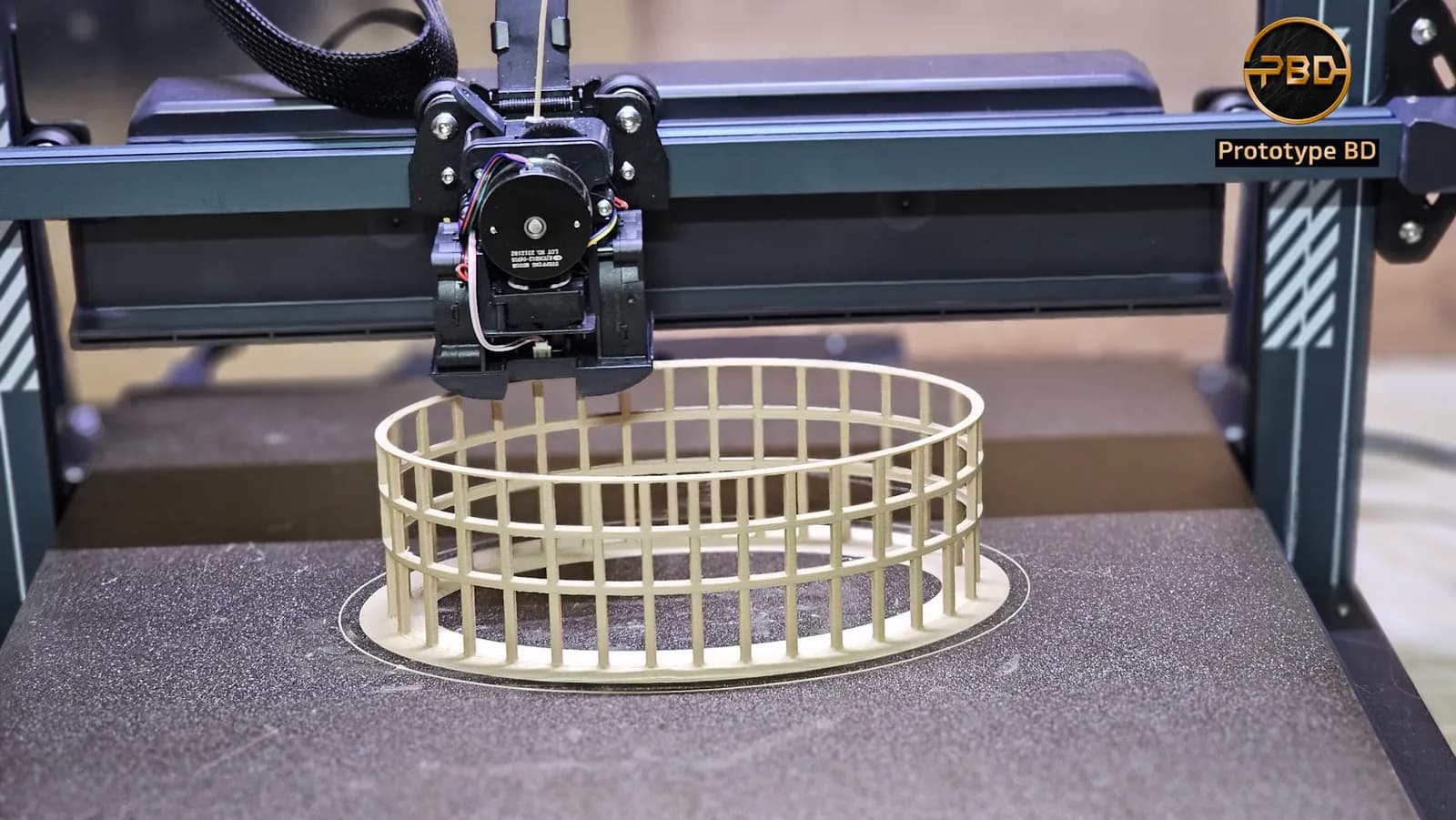
How to 3D Print Overhangs Without Supports
Why FDM overhangs sag, what the 45° rule really measures, how bridges work, and the design and slicer changes that let you print without supports.
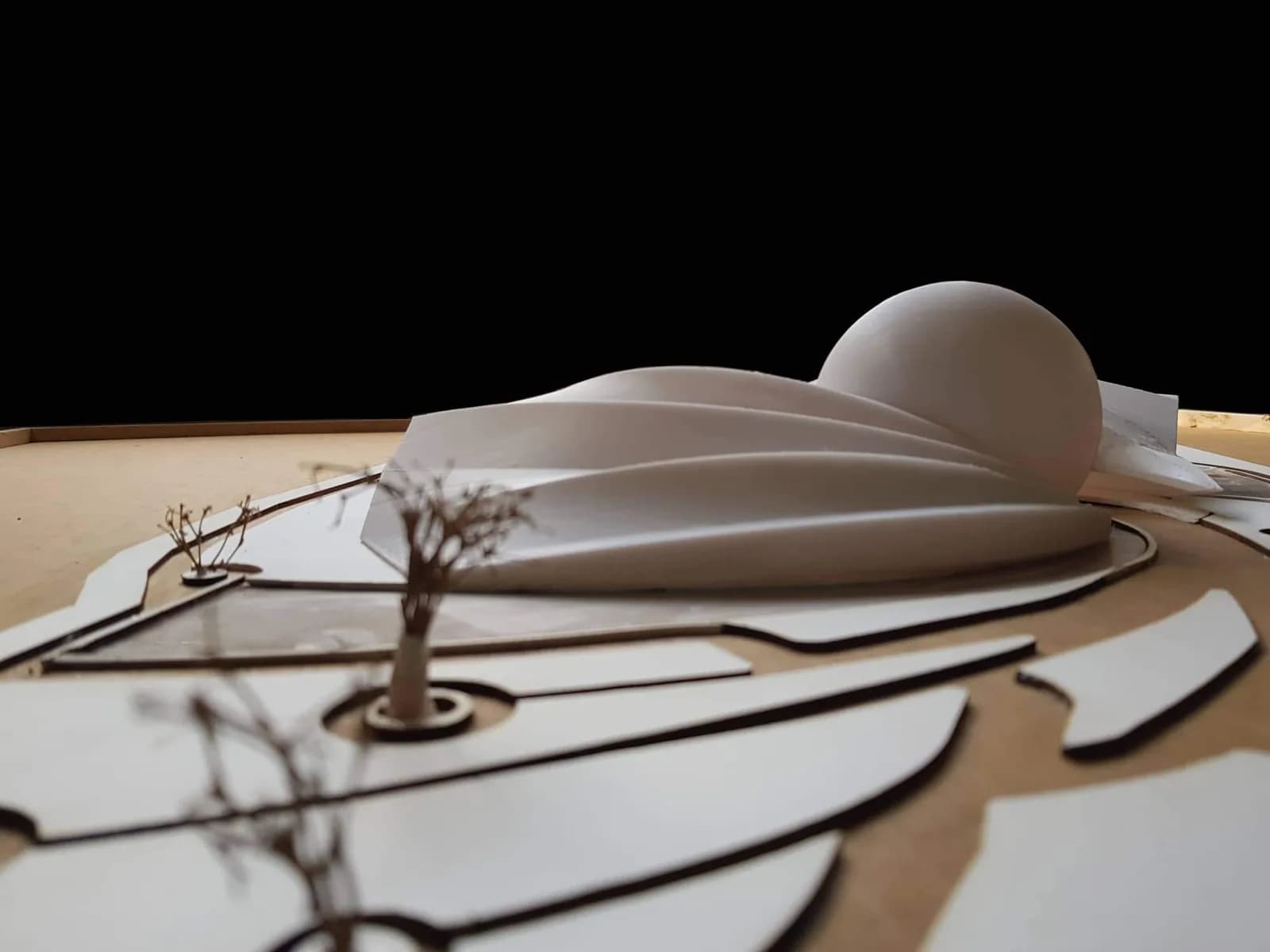
Architectural Model 3D Printing in Bangladesh: Scale, Files and Finish
How to plan a 3D-printed architectural model in Bangladesh: when printing beats hand-making, which scale works, how thin walls can be, how big one piece can be, and what to send.
Comments
Loading comments…